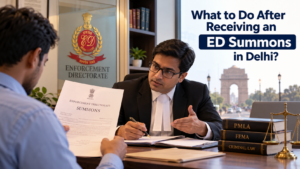

So you’ve received a notice, a summons, or a copy of an FIR from the Economic Offences Wing in Delhi and your first instinct is probably to tell yourself it’s a misunderstanding that will sort itself out. It won’t, not on its own. The short version: talk to a criminal lawyer within the first 48 hours, hold on to every document connected to the transaction in question, and resist the urge to “just explain things” to the investigating officer before you’ve taken proper legal advice. EOW cases move quickly once they’re registered. What you do or don’t do in the first couple of weeks tends to decide how the rest of the case plays out.
This guide breaks down what the EOW actually does, the kinds of cases that typically land there, what happens once a complaint is filed against you (or someone you know), and where a lawyer’s role in these matters differs from an ordinary criminal case.
Quick Summary
| Key Takeaways • The EOW is a specialised Delhi Police unit for financial and white-collar crime not a civil recovery agency, even though most complaints start as money disputes. • Common EOW cases involve cheating (Section 318 BNS, earlier Section 420 IPC), criminal breach of trust (Section 316 BNS, earlier 406 IPC), forgery, cheque fraud, chit funds, and Ponzi-style investment schemes. • Getting a notice doesn’t mean you’re guilty, but ignoring it can lead to a non-bailable warrant. • Anticipatory bail (Section 482 BNSS) and FIR quashing (Section 528 BNSS) are the two tools lawyers use most often to protect the accused early on. • A lawyer’s real value in an EOW matter is in the first two weeks, documentation, representation before the IO, and deciding whether to seek bail or pursue quashing. |
What Is the Economic Offences Wing, and Why Would Your Case End Up There?
The EOW is a dedicated wing of Delhi Police that deals with financial crimes, cases where money, property, or business dealings are involved, rather than violent or ordinary street crime. It sits at Mandir Marg in New Delhi and runs its own complaint portal at eow.delhipolice.gov.in, separate from your local police station.
Here’s the part most people don’t realise until it’s too late: a case doesn’t need to be a “big fraud” to land at the EOW. A business partner who feels shortchanged, an investor who’s unhappy with returns, a builder-buyer dispute, or even a personal loan gone bad can all be framed as cheating or criminal breach of trust and routed to the EOW instead of the local thana. That’s partly why so many EOW complaints are, in reality, civil disputes dressed up in criminal language, and it’s also why the first response to a notice matters so much.
What Kinds of Cases Actually Go to the EOW in Delhi?
| Type of Case | What It Usually Looks Like | Section (BNS / old IPC) |
| Cheating | Money or property taken on a false promise or misrepresentation | 318 BNS (420 IPC) |
| Criminal breach of trust | Property entrusted to someone is misused or not returned | 316 BNS (406 IPC) |
| Forgery / document fraud | Fake signatures, forged agreements, fabricated invoices | 336 BNS (465 IPC) |
| Cheque dishonour | Cheque bounces for insufficient funds after a transaction | Sec. 138, NI Act |
| Chit fund / Ponzi schemes | Investors promised high returns that were never paid out | 318 BNS + Chit Funds Act |
| Builder-buyer / real estate fraud | Delayed or non-delivery of flats, diversion of buyer funds | 318 & 316 BNS |
| Corporate/business fraud | Misrepresentation in partnership, siphoning of company funds | 318, 316, 61(2) BNS |
| Online financial fraud | UPI scams, fake investment apps, digital payment fraud | 318 BNS + IT Act |
Worth noting: since July 2024, the Bharatiya Nyaya Sanhita (BNS) has replaced the IPC, so newer FIRs will cite the new section numbers even though most lawyers, judges, and even police officers still refer to the old IPC numbers out of habit. If your FIR mentions “420” or “406,” that’s the same offence now sitting under 318 and 316 BNS.
You’ve Received an EOW Notice, What Happens Next?
- Complaint / PE (Preliminary Enquiry): Before registering an FIR, the EOW often conducts a preliminary enquiry, especially in financial disputes, to check whether there’s a genuine criminal element or if it’s purely civil in nature.
- Notice under Section 35(3) BNSS (earlier Section 41A CrPC): You may be called in for questioning without being arrested outright. This is the stage where legal representation makes the biggest difference.
- FIR registration: If the enquiry finds enough basis, an FIR is registered and a proper investigation begins.
- Investigation: Statements, documents, bank records, and sometimes forensic accounting are collected.
- Chargesheet or closure report: The case either proceeds to trial or is closed for lack of evidence.
A lawyer’s job at each of these stages is different, at the notice stage, it’s about how you respond and what you say (or don’t say) on record. Once an FIR is filed, the focus shifts to bail, and possibly to challenging the FIR itself if it looks like a civil dispute wearing a criminal mask.
Should You Apply for Anticipatory Bail?
If you have reason to believe an FIR is coming, or has already been filed, and there’s a real risk of arrest, anticipatory bail under Section 482 BNSS (the old Section 438 CrPC) is usually the first line of defence. Courts look at factors like your cooperation with the investigation, flight risk, and whether custodial interrogation is genuinely necessary for the case. In financial matters, where most of the “evidence” is documentary rather than something that can be tampered with in police custody, courts have often been willing to grant anticipatory bail, but this really depends on the specific facts, so it’s not something to assume automatically.
Can an EOW FIR Be Quashed?
Yes, in the right circumstances. High Courts have inherent power under Section 528 BNSS (formerly Section 482 CrPC) to quash an FIR if it’s found to be an abuse of the legal process for instance, when a purely civil or commercial dispute has been dressed up as a criminal complaint to pressure the other side into a settlement. This isn’t a given; the court will look closely at whether the ingredients of the offence (like dishonest intention from the very start, in a cheating case) are actually made out from the complaint itself. But where they aren’t, quashing can end the matter well before trial.
How a Lawyer Actually Helps (Beyond the Obvious)
People often assume a criminal lawyer’s job starts the moment you’re arrested. In EOW matters, the more useful work almost always happens earlier. It begins with actually reading the complaint closely — is this a genuine criminal allegation, or a civil dispute someone has decided to dress up as one? From there, it’s about preparing you before any questioning, so you don’t end up saying something on record that works against you later.
A good lawyer will also pull together the paper trail that matters, agreements, bank statements, even WhatsApp or email threads, to show what your actual intent was at the time. And depending on how things stand, the call often comes down to anticipatory bail versus a quashing petition; these aren’t interchangeable, and picking the wrong one can waste time you don’t have. A fair number of EOW disputes also end in a negotiated settlement, and that’s frequently the outcome that serves the client best lawyer who’s only interested in a courtroom fight isn’t necessarily doing you a favour.
Common Mistakes People Make
- Ignoring that first notice, hoping it quietly goes away, it doesn’t.
- Sitting down with the investigating officer and answering questions without a lawyer in the room.
- Deleting old messages or records connected to the transaction. This backfires almost every time, if it surfaces later, and it usually does, it looks far worse than whatever was actually in those messages.
- Assuming a civil dispute could never turn criminal. It can, and in Delhi’s EOW, it does, fairly often.
- Waiting for an FIR before calling a lawyer, when the smarter move is acting the moment a notice arrives.
Choosing the Right EOW Lawyer in Delhi
Look for someone who specifically handles white-collar and economic offence matters, not just general criminal practice, the way EOW investigations work (documentary evidence, forensic accounting, financial trails) is different from, say, a theft or assault case. Ask about their experience with anticipatory bail and quashing petitions specifically, since these are the two remedies you’re most likely to need early on. And be wary of anyone who promises a guaranteed outcome before even reading your documents, no honest lawyer can do that.
Frequently Asked Questions
What is the EOW in Delhi Police?
The Economic Offences Wing is a specialised unit of Delhi Police that investigates financial and white-collar crimes, cheating, breach of trust, forgery, chit fund fraud, and similar offences, separately from regular police stations.
I got a notice from the EOW, does that mean I’ll be arrested?
Not necessarily. A notice, especially one issued under Section 35(3) BNSS, is often just a call for questioning during a preliminary enquiry. Arrest isn’t automatic, but how you handle the notice matters a great deal.
Can a civil dispute really become an EOW case?
Yes. Business disagreements, unpaid loans, and property disputes are sometimes filed as cheating or criminal breach of trust complaints. Courts are aware of this pattern, which is why quashing petitions exist for genuinely civil matters wrongly framed as criminal.
How long does an EOW investigation usually take?
It varies widely depending on the complexity of the financial trail, straightforward cheque-related matters can move faster, while multi-party fraud or Ponzi scheme investigations can take many months.
Is bail available in EOW cases?
Most EOW offences are bailable or allow for anticipatory bail under Section 482 BNSS, though this depends on the specific sections invoked and the facts of the case.
Do I need a lawyer if I’m just a witness, not the accused?
It’s still worth a quick consultation. Witness statements in financial cases can sometimes shift how the investigation views your role, so it helps to know what you’re walking into.
Don’t Wait for the Next Notice to Land
Here’s the honest truth about EOW cases: the costliest mistake usually isn’t a weak argument in court, it’s the week or two people spend deciding whether they really need a lawyer yet. By the time that decision gets made, some of the easier options, anticipatory bail before an arrest, a calm response at the preliminary-enquiry stage, a quashing petition before things escalate, have often already narrowed.
If you’re holding an EOW notice, an FIR copy, or even just a phone call telling you the police want to speak with you about a case in your name, that’s the moment to reach out. Not next week, not after you’ve “figured out what’s going on” on your own.